TWO:Grattan determined to call these Acts in question in the Irish Parliament, and at least abolish them there. This alarmed even Burke, who, writing to Ireland, said, "Will no one stop that madman, Grattan?" But Grattan, on the 19th of April, 1780, submitted to the Irish House of Commons a resolution asserting the perfect legislative independence of Ireland. He did not carry his motion then, but his speech¡ªin his own opinion, the finest he ever made¡ªhad a wonderful effect on the Irish public. Other matters connected with sugar duties, and an Irish Mutiny Bill, in which Grattan took the lead, fanned the popular flame, and the Volunteer body at the same time continued to assume such rapidly growing activity that it was deemed necessary by Government to send over the Earl of Carlisle to supersede the Earl of Buckinghamshire, and to give him an able secretary in Mr. Eden. But this did not prevent the Irish Volunteers from meeting at Dungannon on the 15th of February, 1782. There were two hundred and forty-two delegates, with their general-in-chief, Lord Charlemont, at their head, and they unanimously passed a resolution prepared by Grattan, "That a claim of any body of men other than the King, Lords, and Commons of Ireland, to bind this kingdom, is unconstitutional, illegal, and a grievance." On the 22nd, Grattan moved a similar resolution in the Irish House of Commons, which was only got rid of by the Attorney-General asking for some time to consider it. Two days only before Grattan had made his motion on Irish rights, that is, on the 20th of February, he seconded a Bill for further relief of Roman Catholics in Ireland, introduced by Mr. Gardiner. The Bill was passed, and wonderfully increased the influence of Grattan by adding the grateful support of all the Catholics. Such was the tone of Ireland, and such the transcendent influence of Grattan there, when the new Whig Ministry assumed office.
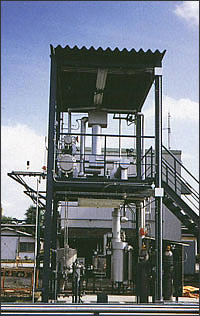
Great attention is recently being paid to global environmental issues, and it is now conceivable that companies will need to treat used solvents themselves. In consideration of this kind of social issue, we have developed a “membrane separation type solvent dehydration system,” which uses a polyimide membrane with superior dehydration properties developed by Ube Industries, Ltd. in combination with our own distillation and concentration technology that has resulted in solvents being more easily recovered.
THREE:
- 1Under the distillation system, even in case of azeotropic solvent compositions, this system which remove water vapor by the polyimide membrane will easily dehydrate.
- 2In comparison with the distillation system, it significantly saves on use of steam.
- 3Dehydration can be performed through merely supplying evaporated vapor to the membrane module and maintaining the differential pressure between the permeable side and the impermeable side.
- 4Solvent purity of 99.9% or more can be achieved by carrying out dehydration with a polyimide membrane only.
- 5The polyimide membrane has superior heat and solvent resistance. Therefore, the vapor permeation system reduces contamination of the membrane and thus extends its life.
THREE:101
The aromatic polyimide membrane is highly permeable to water vapor but less permeable to vapors of organic compounds such as alcohol etc.
THREE:Granville being got rid of, and the Opposition bought up with place, the only difference in the policy which had been pursued, and which had been so bitterly denounced by the noblemen and gentlemen now in office, was that it became more unequivocally Hanoverian and more extravagant. "Those abominably Courtly measures" of Granville were now the adopted measures of his denouncers. The king had expressed, just before his fall, a desire to grant a subsidy to Saxony; but Lord Chancellor Hardwicke had most seriously reminded his Majesty of the increased subsidy to the Queen of Hungary, which made it impracticable: now, both the increased subsidy to Maria Theresa and the subsidy to Saxony were passed without an objection. A quadruple alliance was entered into between Britain, Austria, Holland, and Saxony, by which Saxony was to furnish thirty thousand men for the defence of Bohemia, and to receive a hundred and fifty thousand pounds, two-thirds of which were to be paid by England, and one-third by Holland. The Elector of Cologne received twenty-four thousand pounds, the Elector of Mayence eight thousand pounds. Nay, soon discovering that, as there was no opposition, there was no clamour on the subject, Ministers the very next year took the Hanoverians into their direct pay again, and in 1747 increased the number of them from eighteen thousand to twenty thousand.261
- 1 Recovery of the detergent solvent Recovery of the cleaning solvent such as electronic parts industry, precision instrument industry.
- 2Solvent recovery and the refinement Solvent recovery and the refinement such as chemical industry, an industry of medical supplies, food industry, the fermentation industry.
THREE:
Acetone, ethanol, methyl ethyl ketone, butanol, isopropyl alcohol, ethyl acetate, methyl isobutyl ketone, others (including hexane and toluene).
